In today’s highly competitive business environment, gaining new customers is important — but retaining existing customers is even more valuable. Businesses across industries are now realizing that long-term growth depends heavily on customer loyalty, repeat business, and strong customer relationships.

This is where telecalling services play a powerful role.

Professional telecalling and customer communication strategies help businesses maintain regular customer interaction, improve satisfaction, resolve issues faster, and build trust. From real estate and educational institutes to finance, healthcare, retail, and IT companies, businesses are increasingly using customer retention strategies through telecalling to reduce customer churn and improve long-term profitability.

Companies like Reliable Communication help businesses strengthen customer engagement through structured outbound calling services, customer support solutions, and follow-up communication systems.

Why Customer Retention Is Important for Business Growth

Customer retention directly impacts:

  • Revenue growth
  • Customer loyalty
  • Brand reputation
  • Customer lifetime value
  • Referral business
  • Operational profitability

Studies consistently show that retaining existing customers costs significantly less than acquiring new ones.

Satisfied customers are more likely to:

  • Purchase repeatedly
  • Recommend your business
  • Leave positive reviews
  • Trust your services
  • Engage with your brand long term

Businesses that focus on customer retention strategies often grow faster and maintain more stable revenue streams.

How Telecalling Helps Improve Customer Retention

Human communication still remains one of the most effective ways to build customer trust.

Unlike automated systems or generic emails, telecalling creates direct personal interaction that helps businesses:

  • Build relationships
  • Solve customer problems quickly
  • Understand customer expectations
  • Improve customer satisfaction
  • Maintain regular engagement

Professional telecalling services help businesses create a stronger emotional connection with customers, which directly improves retention rates.

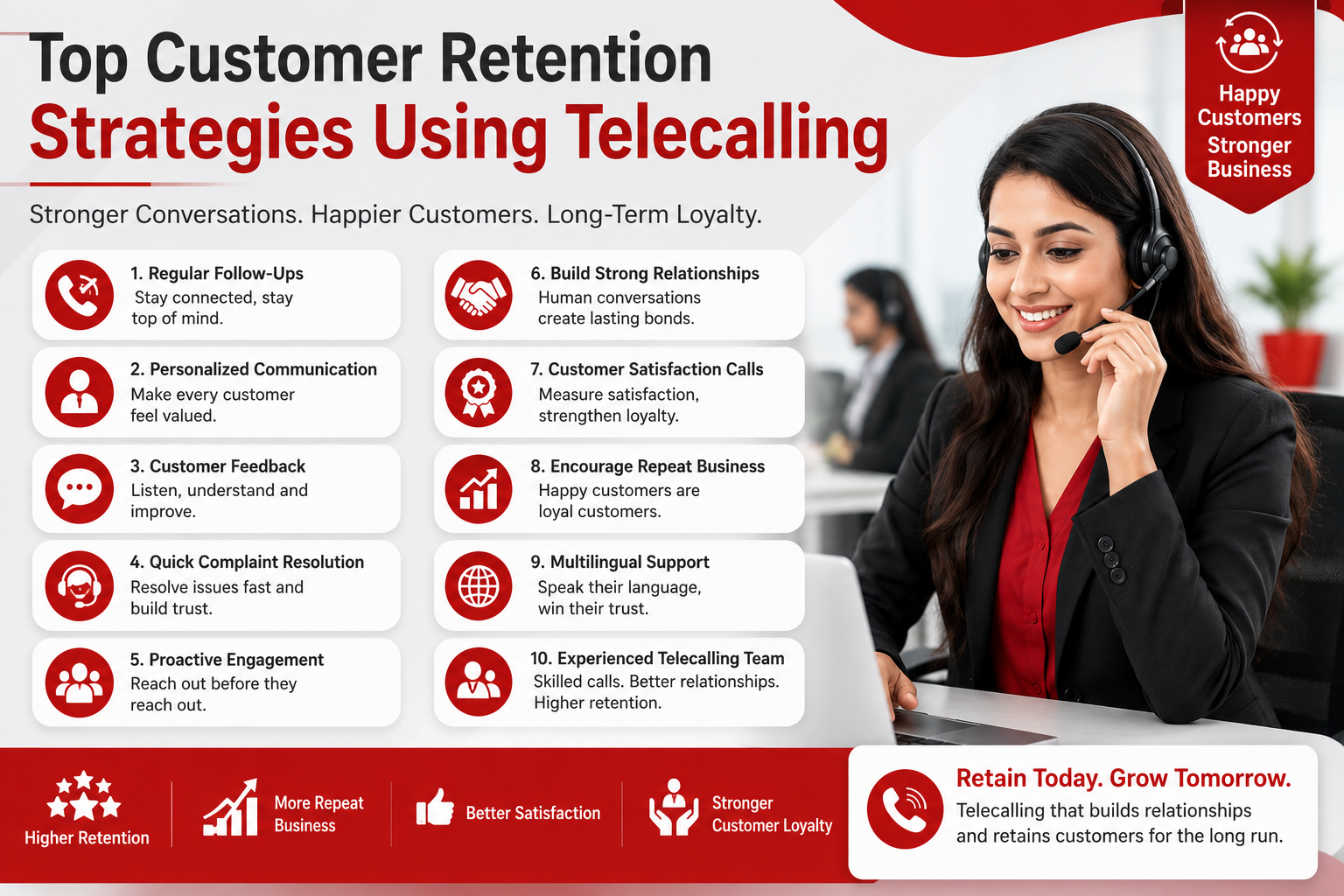
Top Customer Retention Strategies Using Telecalling

  1. Regular Follow-Up Calls

One of the most effective customer retention techniques is consistent follow-up communication.

Many businesses lose customers simply because they stop engaging after the initial sale.

Regular follow-up calls help businesses:

  • Stay connected with customers
  • Understand post-purchase experiences
  • Offer additional support
  • Build trust and loyalty
  • Improve customer satisfaction

Professional outbound calling teams ensure customers feel valued even after completing a purchase or service.

  1. Personalized Customer Communication

Customers prefer businesses that understand their needs.

Personalized telecalling strategies involve:

  • Addressing customers by name
  • Understanding purchase history
  • Providing relevant solutions
  • Offering customized recommendations

This personalized communication creates a positive customer experience and improves long-term engagement.

Businesses using CRM-integrated telecalling services can manage customer interaction more effectively and improve retention.

  1. Customer Feedback Collection

Customer feedback surveys are essential for improving services and understanding customer expectations.

Telephonic survey calling services help businesses collect genuine customer insights through human interaction.

Feedback calls help identify:

  • Service quality issues
  • Customer complaints
  • Product improvement areas
  • Customer satisfaction levels

Businesses that actively listen to customers build stronger customer relationships and reduce customer churn.

  1. Quick Complaint Resolution

Fast issue resolution is one of the biggest drivers of customer loyalty.

Customers become frustrated when their concerns are ignored or delayed.

Dedicated customer support telecalling teams help businesses:

  • Respond faster
  • Handle complaints professionally
  • Provide real-time assistance
  • Maintain customer trust

Quick response systems significantly improve customer experience and brand reputation.

  1. Proactive Customer Engagement

Businesses should not wait for customers to contact them.

Proactive telecalling strategies include:

  • Service reminder calls
  • Renewal reminders
  • Product update calls
  • Relationship-building conversations
  • Special offer notifications

This regular engagement helps businesses remain visible and connected with customers.

  1. Building Trust Through Human Interaction

Despite the rise of automation and AI chatbots, human communication still plays a major role in customer retention.

Customers trust businesses more when they can speak directly with real people.

Telecalling services create:

  • Emotional connection
  • Better communication clarity
  • Personalized support
  • Faster understanding of customer needs

This human touch helps businesses maintain long-term customer loyalty.

  1. Customer Satisfaction Calls

Customer satisfaction calling services help businesses understand how customers feel about their products, services, or support experience.

These calls help businesses:

  • Improve customer experience
  • Measure service quality
  • Identify dissatisfied customers early
  • Prevent negative online reviews

Businesses that regularly monitor customer satisfaction perform better in competitive markets.

  1. Lead Nurturing and Relationship Management

Not all customers make immediate purchasing decisions.

Telecalling helps businesses nurture leads and maintain long-term relationships through:

  • Follow-up communication
  • Product education
  • Trust-building conversations
  • Appointment scheduling
  • Customer engagement campaigns

Strong relationship management improves both customer retention and conversion rates.

  1. Multilingual Customer Support

India’s diverse customer base requires communication in multiple languages.

Multilingual telecalling services improve customer comfort and communication quality, especially in industries like:

  • Real estate
  • Healthcare
  • Educational institutes
  • Finance
  • Telecom

Customers are more likely to stay loyal to businesses that communicate comfortably in their preferred language.

  1. Outsourcing Professional Telecalling Services

Many businesses struggle to manage customer communication internally due to:

  • Lack of trained staff
  • Operational costs
  • Time limitations
  • Scaling challenges

Outsourcing customer communication and telecalling services helps businesses:

  • Reduce operational burden
  • Improve customer engagement
  • Increase efficiency
  • Maintain professional communication standards

Professional telecalling companies like Reliable Communication provide structured customer communication solutions that help businesses improve customer retention and customer satisfaction.

Industries That Benefit Most from Customer Retention Telecalling

Real Estate

Builders use telecalling for:

  • Site visit follow-ups
  • Buyer engagement
  • Project updates
  • Customer relationship management

Educational Institutes

Schools and colleges use telecalling for:

  • Admission follow-up
  • Parent communication
  • Student engagement
  • Feedback collection

Healthcare

Hospitals use customer support calling for:

  • Appointment reminders
  • Patient feedback
  • Service support
  • Relationship management

Finance & Insurance

Financial companies use telecalling for:

  • Policy renewals
  • Investment follow-up
  • Customer engagement
  • Relationship management

Retail & E-commerce

Retail businesses use telecalling to:

  • Improve customer experience
  • Handle complaints
  • Offer personalized recommendations
  • Increase repeat purchases

Why Telecalling Still Works in 2026

Even with AI tools and automated communication systems, telecalling remains highly effective because customers still value human interaction.

Telecalling provides:

  • Personalized communication
  • Better customer understanding
  • Real-time problem resolution
  • Emotional connection
  • Stronger relationship building

Businesses combining technology with professional human communication are achieving better customer retention results.

How Reliable Communication Helps Businesses Improve Customer Retention

Reliable Communication is a professional customer communication and telecalling company based in Pune.

The company provides:

  • Outbound calling services
  • Customer follow-up services
  • Customer satisfaction surveys
  • Lead nurturing support
  • Contact center services
  • Customer engagement campaigns
  • Multilingual telecalling support
  • CRM-based communication management

Reliable Communication helps businesses across industries improve customer interaction, customer loyalty, and long-term business growth through structured telecalling solutions.

Conclusion

Customer retention is one of the most important factors for sustainable business growth.

Businesses that invest in professional customer communication strategies gain significant advantages in:

  • Customer loyalty
  • Repeat business
  • Brand trust
  • Customer satisfaction
  • Revenue stability

Telecalling remains one of the most effective customer retention tools because it creates direct human connection and personalized communication.

From follow-up calling and customer feedback collection to complaint resolution and relationship management, professional telecalling services help businesses maintain strong customer relationships and scale faster.

Businesses looking to improve customer retention and customer engagement can partner with Reliable Communication for professional telecalling and customer communication solutions.

In today’s highly competitive real estate market, generating quality leads is only half the battle. The real challenge for builders and real estate companies is converting inquiries into actual property site visits.

Many potential buyers show interest online, fill inquiry forms, or click on ads — but without proper follow-up communication, those leads often go cold.

This is where real estate telecalling services play a critical role.

Professional telecalling teams help builders and developers engage leads, build trust, answer customer queries, schedule appointments, and ultimately increase property site visits.

Companies like Reliable Communication provide specialized telecalling and customer communication services that help real estate businesses improve lead conversion and sales performance.

Why Site Visits Matter in Real Estate Sales

In real estate, site visits are one of the most important stages in the sales funnel.

Most property buyers do not make purchasing decisions based only on online advertisements or brochures. They want to:

  • Visit the property location
  • Experience the project physically
  • Understand amenities
  • Evaluate connectivity
  • Interact with sales representatives
  • Build trust with the builder

The more site visits a project receives, the higher the chances of property bookings and conversions.

This is why real estate companies heavily focus on site visit generation strategies and customer follow-up communication.

Challenges Real Estate Companies Face in Lead Conversion

Real estate businesses often generate large numbers of leads through:

  • Google Ads
  • Meta Ads
  • Property portals
  • Social media campaigns
  • Landing pages
  • Referral marketing

However, many companies struggle with:

  • Delayed follow-up
  • Unattended leads
  • Poor customer communication
  • Low lead engagement
  • Missed site visit opportunities
  • Inconsistent follow-up processes

Without structured communication systems, even high-quality property leads may never convert into site visits.

How Telecalling Services Help Real Estate Companies

  1. Faster Lead Response Improves Conversion

Speed matters in real estate lead generation.

When a potential buyer submits an inquiry, immediate follow-up significantly increases the chances of conversion.

Professional outbound telecalling teams help builders:

  • Respond quickly to inquiries
  • Connect with leads instantly
  • Understand buyer requirements
  • Maintain customer engagement

Quick response builds customer confidence and increases the probability of scheduling a property site visit.

  1. Personalized Customer Communication

Every property buyer has different preferences, budgets, and requirements.

Professional telecalling services provide personalized communication based on:

  • Budget range
  • Preferred location
  • Property type
  • Family requirements
  • Investment goals

This personalized interaction helps build trust and improves customer engagement.

Human communication remains far more effective than automated responses in real estate sales.

  1. Lead Qualification and Filtering

Not every inquiry is a serious buyer.

Telecalling services help real estate companies qualify leads by identifying:

  • Genuine buyers
  • Budget suitability
  • Purchase timeline
  • Investment intent
  • Site visit readiness

This helps builders focus their sales efforts on high-potential leads and improve conversion efficiency.

  1. Site Visit Appointment Scheduling

One of the biggest advantages of telecalling is appointment coordination.

Professional telecalling teams help:

  • Schedule site visits
  • Confirm appointments
  • Coordinate timings
  • Share project details
  • Send reminders

This organized communication process significantly improves site visit attendance rates.

  1. Continuous Lead Follow-Up

Many real estate buyers do not make immediate decisions.

Consistent follow-up communication is essential to keep leads engaged.

Telecalling teams help builders maintain regular communication through:

  • Follow-up calls
  • Project updates
  • Price change notifications
  • Offer information
  • Construction progress updates

Regular engagement increases customer interest and improves the chances of future site visits.

  1. Building Trust Through Human Interaction

Real estate is a high-value purchase decision.

Customers prefer speaking with real people before making commitments.

Professional telecalling services help create:

  • Personal connection
  • Buyer confidence
  • Better communication clarity
  • Trust-building conversations

This human interaction is extremely important in converting online inquiries into physical property visits.

  1. Handling Customer Queries Professionally

Potential buyers often have multiple questions related to:

  • Pricing
  • EMI options
  • Amenities
  • Connectivity
  • Legal approvals
  • Construction timelines

Dedicated telecalling teams help answer customer queries professionally and maintain buyer engagement.

Clear communication helps reduce confusion and encourages customers to visit the project site.

  1. Improving Real Estate Marketing ROI

Builders invest heavily in digital marketing campaigns.

Without proper follow-up systems, marketing budgets may get wasted.

Professional telecalling services help improve:

  • Lead conversion rates
  • Site visit ratios
  • Customer engagement
  • Sales funnel efficiency
  • Marketing ROI

Effective customer communication ensures that generated leads are properly nurtured and converted.

Why Outsourcing Real Estate Telecalling Services Is Beneficial

Managing an in-house telecalling team can be challenging due to:

  • Hiring costs
  • Training requirements
  • Infrastructure setup
  • Staff management
  • Scalability issues

Outsourcing real estate telecalling services helps businesses:

  • Reduce operational costs
  • Access trained calling professionals
  • Scale campaigns quickly
  • Improve response management
  • Maintain structured communication systems

Professional telecalling companies already have the experience, systems, and customer communication expertise required for real estate lead management.

Role of CRM Integration in Real Estate Telecalling

Modern telecalling services often work with CRM-based communication systems.

CRM integration helps:

  • Track customer interactions
  • Monitor lead stages
  • Schedule follow-ups
  • Manage appointment reminders
  • Analyze conversion performance

This organized lead management process helps real estate companies improve efficiency and conversion rates.

Industries and Projects That Benefit from Real Estate Telecalling

Telecalling services are highly useful for:

  • Residential projects
  • Commercial properties
  • Luxury apartments
  • Township projects
  • Plotting projects
  • Villa projects
  • Affordable housing
  • Pre-launch campaigns

Builders across India are increasingly using telecalling services to improve customer communication and property sales.

Why Telecalling Still Works in 2026

Even with AI chatbots and automated messaging systems, telecalling remains highly effective because:

  • Buyers prefer human communication
  • Property purchases involve emotional decisions
  • Real-time conversations build trust
  • Personalized interaction improves engagement
  • Direct communication improves site visit conversion

Businesses combining digital marketing with professional telecalling services achieve better results than businesses relying only on automated systems.

How Reliable Communication Helps Real Estate Companies

Reliable Communication provides professional real estate telecalling and customer communication services for builders and developers.

Their services include:

  • Real estate outbound calling
  • Lead follow-up services
  • Site visit appointment scheduling
  • Customer engagement support
  • Telemarketing services
  • CRM-based communication management
  • Customer inquiry handling
  • Multilingual telecalling support

Reliable Communication helps real estate companies improve lead nurturing, increase property site visits, and enhance overall sales conversion.

Conclusion

Generating leads is only the beginning of the real estate sales process. The real success lies in converting inquiries into actual property site visits and bookings.

Professional telecalling services help builders:

  • Respond faster
  • Build customer trust
  • Maintain regular follow-up
  • Improve lead qualification
  • Increase site visit conversions
  • Improve marketing ROI

In today’s competitive real estate industry, customer communication has become one of the most important factors for successful lead conversion.

Businesses looking to improve property sales and customer engagement can partner with Reliable Communication for professional telecalling and real estate customer communication solutions.

In real estate, communication doesn’t just support sales —
it decides whether a deal moves forward or dies silently.

Every missed call, delayed follow-up, or poorly routed enquiry directly impacts site visits, conversions, and revenue. Yet most real estate businesses still manage communication using intuition, spreadsheets, or disconnected systems.

Data-driven communication changes this completely.


Real Estate Communication Is a High-Stakes System

A typical real estate communication ecosystem includes:

  • Website and portal enquiries

  • Inbound calls from multiple projects

  • WhatsApp follow-ups and brochures

  • Site visit scheduling

  • CRM updates

  • Channel partner coordination

Each interaction generates critical behavioural data — but most of it remains unused.

The result?
Leads fall through cracks, teams chase the wrong prospects, and management sees only partial reality.


The Hidden Cost of Poor Communication in Real Estate

Real estate businesses often face:

  • Missed or unanswered calls during peak enquiry hours

  • Multiple agents calling the same lead

  • Delayed follow-ups after site visits

  • No visibility into lead quality vs call volume

  • No insight into which campaigns actually convert

These are not sales problems.
They are communication intelligence problems.


What Data-Driven Communication Means for Real Estate

Data-driven communication is about designing communication flows using evidence, not assumptions.

It answers questions like:

  • Which source delivers serious buyers, not just enquiries?

  • How fast should follow-ups happen to maximise site visits?

  • Which agent communication style converts better?

  • When should automation step in — and when should humans intervene?

For real estate, these answers directly affect revenue velocity.


Key Communication Decisions That Must Be Data-Led

1. Lead Routing & Response Time

Speed is everything in real estate.

Data helps determine:

  • Ideal response time per lead source

  • Skill-based routing (new lead vs hot prospect)

  • Time-of-day call success rates

This ensures the right lead reaches the right agent at the right moment.


2. Channel Strategy: Calls vs WhatsApp vs Automation

Not every enquiry needs a call.

Data reveals:

  • Which prospects respond better on WhatsApp

  • When automated nudges increase site visit confirmations

  • Where human conversations are essential to close deals

This reduces agent fatigue while improving engagement quality.


3. Site Visit Conversion Intelligence

Many leads schedule site visits — fewer convert.

Data-driven communication helps analyze:

  • Follow-up timing after site visits

  • Call frequency vs drop-offs

  • Messaging that increases second visits

This turns communication into a conversion accelerator, not just a reminder system.


4. Agent Performance & Training Insights

Instead of subjective reviews, data enables:

  • Call outcome analysis

  • Script effectiveness tracking

  • Objection handling insights

  • Conversion-to-call ratios per agent

This allows targeted coaching instead of blanket pressure.


5. Campaign & Project-Level Visibility

Marketing spend without communication data is incomplete.

Data connects:

  • Campaign source → call quality → site visits → bookings

  • Project-wise enquiry patterns

  • Agent performance per project

This empowers leadership with real-time decision clarity.


Why Real Estate Needs This Now More Than Ever

The market is more competitive and customer expectations are higher:

  • Faster responses

  • Clear information

  • Fewer follow-ups

  • Seamless handoffs between teams

Without data-driven communication:

  • Trust erodes

  • Costs increase

  • Sales cycles stretch

With it:

  • Lead wastage reduces

  • Conversions improve

  • Sales teams work smarter, not harder


The Role of a Strategic Communication Partner

Implementing data-driven communication in real estate is not just about software.

It requires:

  • Communication audits across projects

  • Telecom and CRM integration

  • Process redesign for lead handling

  • Automation with human balance

  • Continuous performance optimisation

This is where Reliable Communications adds value — helping real estate businesses build intelligent, scalable communication systems that directly impact sales outcomes.


Final Perspective

Real estate success depends on timing, trust, and clarity.
Data-driven communication ensures none of these are left to chance.

When communication is guided by insight, every call, message, and follow-up works with purpose.

That’s how modern real estate businesses scale.

Struggling with missed leads or inefficient follow-ups?
Reliable Communications helps real estate businesses design data-driven communication frameworks that improve response time, conversions, and visibility.

📞 Speak with our real estate communication specialists.

Admissions are the lifeline of every educational institute. Whether it is a reputed college in Pune, a private school, or a professional training institute, the admission cycle brings with it enormous challenges. From reaching prospective students to handling inquiries and following up with parents, the entire process can become overwhelming when managed in-house. This is where Reliable Communication – one of the top Call Center and Telesales company in Pune – stepped in to transform the way schools and colleges approach admissions.

Understanding the Admission Challenges in Schools and Colleges

Educational institutions often rely on their internal administrative staff to manage inquiries, calls, and follow-ups during admission season. While this may work on a small scale, larger institutions face several pain points:
• High call volumes leading to unanswered inquiries.
• Untrained staff struggling to handle parent and student queries professionally.
• Poor follow-up systems resulting in loss of potential admissions.
• Time constraints, as faculty and administrative teams get pulled away from their core duties.

One leading college in Pune shared how their admission team, despite working long hours, was unable to keep up with over 5,000 inquiries during the admission season. They realized they needed a dedicated solution that combined professional tele-calling expertise with a structured admission process. That’s when they partnered with Reliable Communication.

Why Reliable Communication?

As a Call center company in Pune with years of experience in handling tele-sales and customer outreach, Reliable Communication brings:
• A dedicated tele-calling team trained to handle educational inquiries.
• Multilingual support, enabling smooth communication with parents and students across Maharashtra and India.
• Data-driven admission follow-ups, ensuring every lead is nurtured until closure.
• Professional systems that maintain accuracy, consistency, and student data confidentiality.

For schools and colleges, this meant outsourcing the stress of admissions to experts who not only understand calling but also the sensitive nature of interacting with parents and students.

Applying the E-E-A-T Framework

Reliable Communication follows the E-E-A-T principles – Experience, Expertise, Authoritativeness, and Trustworthiness – to build lasting partnerships with educational institutions.
• Experience: Years of working with schools, colleges, and training institutes have given Reliable Communication deep insights into how admission seasons operate.
• Expertise: Their team is well-trained in professional tele-calling, objection handling, and persuasive communication – all critical in converting inquiries into confirmed admissions.
• Authoritativeness: As a recognized tele-calling company for school and college admissions, Reliable Communication has built a reputation in Pune and beyond for delivering results.
• Trustworthiness: Confidentiality of student and parent data is a top priority, ensuring institutions can rely on them without hesitation.

Case Study: How Outsourcing Admissions Helped a Pune College Grow

A reputed management college in Pune was struggling with its in-house admission team. Despite running digital campaigns and offline promotions, they noticed a 40% drop in conversions compared to the previous year. The key issue? Their in-house team could not handle the follow-up process effectively.

After partnering with Reliable Communication:

• The tele-calling team contacted every student who had shown interest within 24 hours.
• Customized call scripts helped address parent concerns around course fees, placements, and faculty.
• Regular follow-ups were scheduled until the admission was confirmed.
• Reports and dashboards gave the college clear insights into the progress.

Within just one admission cycle, the college saw a 60% increase in admissions and a smoother process overall. The Dean later admitted that outsourcing the calling process was one of their best strategic decisions, as it allowed faculty to focus on academics while Reliable Communication managed outreach professionally.

Benefits of Admissions Process Outsourcing

For schools, colleges, and institutes, the benefits of outsourcing admissions to a trusted partner like Reliable Communication are significant:
1. Scalability – Whether an institute gets 500 inquiries or 50,000, Reliable Communication can scale operations quickly.
2. Professional Communication – Parents and students receive polite, informed, and clear responses.
3. Data Management – Every inquiry is tracked, categorized, and followed up systematically.
4. Time-Saving – Internal staff are free to focus on academics, administration, and student services.
5. Higher Conversion Rates – With structured follow-ups, institutes see a direct increase in admissions.

How Schools and Institutes Have Benefited

• Private Schools in Pune: By outsourcing to Reliable Communication, schools improved their enrollment numbers and ensured parents always received timely updates about admission procedures.
• Engineering Colleges: Colleges running multiple admission rounds benefited from structured call campaigns that guided students at every step.
• Training Institutes: For skill development centers, Reliable Communication’s telesales expertise helped convert inquiries into course enrollments with higher efficiency.

Reliable Communication’s Approach

The company doesn’t believe in a one-size-fits-all solution. For every institution, they:
• Understand the admission goals.
• Build customized tele-calling scripts.
• Train callers to represent the institute professionally.
• Provide transparent reports and progress updates.
This tailored approach ensures that schools, colleges, and institutes see real impact during their admission cycles.

A Smarter Way Forward for Admissions

In today’s competitive education environment, schools and colleges cannot afford to miss out on potential students due to poor follow-up or ineffective communication. Partnering with Reliable Communication – the leading call center company in Pune for school and college admissions – ensures that admissions are handled with professionalism, empathy, and efficiency.
If your institute is looking to simplify its admission process, increase conversions, and provide a better experience for parents and students, it’s time to explore admissions process outsourcing for schools, colleges, and institutes with Reliable Communication.

Connect with Reliable Communication today and discover how our call center, telesales, and tele-calling services can help your school, college, or institute achieve its admission goals with ease. Visit www.reliablecommunication.co.in to know more.

Have you ever asked a friend if they could come over to play, and they said, “Maybe”? It can be confusing, right? You’re not sure if they will come or not. This is kind of like what happens in business when people say “maybe” to buying something. Additionally, They haven’t made up their minds yet. But guess what? There’s a way to turn that “maybe” into a “yes,” and it’s called a follow-up call!

What is a Follow-Up Call?

A follow-up call is when someone calls another person again to remind them about something they talked about earlier. In business, this usually happens after someone shows interest in buying a product but hasn’t made a decision yet. Moreover, Think of it like reminding your friend about your invitation to play; you call them again to see if they have decided yet.

Why Are Follow-Up Calls Important?

Imagine you ask your friend to come over once, and they say, “Maybe,” but then you never talk about it again. They might forget or think you don’t really care if they come or not. Additionally, The same thing happens in business. If someone says “maybe” and they don’t hear back, they might forget or lose interest. A follow-up call shows that you care and helps them remember why they were interested in the first place.

How Do Follow-Up Calls Work?

  1. Friendly Reminder: A follow-up call is like a gentle nudge. It’s a friendly reminder about the last conversation. Moreover, It’s like saying, “Hey, remember how you liked this toy? Do you still want it?”
  2. Answering Questions: Sometimes, people say “maybe” because they have questions or are unsure about something. A follow-up call gives them a chance to ask more questions and get more information. Just like your friend might ask, “What game will we play?” before deciding to come over.
  3. Showing That You Care: Making a follow-up call shows that you care about the person and their decision. Moreover, It’s like when you really want your friend to come over, so you check in with them. It shows that you’re interested in them and not just in making a sale.

Tips for a Good Follow-Up Call

Making a follow-up call isn’t just about reminding someone; it’s about doing it the right way. Here are some tips to make sure the call goes well:

  1. Be Friendly: Always be nice and polite. Think of how you would talk to your friend. You want the person to feel comfortable and happy to talk to you.
  2. Ask Questions: Find out if they have any doubts or need more information. Asking questions shows you care about their needs.
  3. Listen Carefully: Pay attention to what the person says. Additionally, Listening is very important because it helps you understand what they want or need.
  4. Be Patient: Don’t rush them. Moreover,Sometimes, people need time to think before making a decision. Give them the space they need to decide.

Real-Life Example: Turning “Maybe” into “Yes”

Let’s say you have a lemonade stand. One day, a person stops by and tastes your lemonade. They say it’s good but don’t buy it right away. Instead, they say, “Maybe I’ll come back later.” A follow-up call is like waving at them the next day and saying, “Hey, remember how much you liked the lemonade? We have a fresh batch today! Would you like some?”
By doing this, you remind them how much they liked it and encourage them to buy. They might say, “You know what? I do want some lemonade!” And just like that, a “maybe” becomes a “yes.”

Why Follow-Up Calls Matter

Follow-up calls are important because they help keep the conversation going. They turn a maybe into a yes by:

  • Reminding: People often get busy and forget. A follow-up call reminds them about what they liked.
  • Clarifying: It helps clear up any doubts or questions they might have.
  • Connecting: It builds a connection and shows that you care about their decision.

In the end, follow-up calls are all about being helpful and friendly. Moreover, They are a great way to turn a “maybe” into a “yes” by reminding people of what they were interested in, answering their questions, and showing that you care. So next time someone says “maybe,” remember that a follow-up call could be just what they need to make up their mind!

Telemarketing is when people call others on the phone to talk about products or services. It might sound easy, but it takes a lot of practice and skill to do it well. If you have a telemarketing team, you want them to work as efficiently as possible. Efficiently means getting the job done in the best way without wasting time or effort. Here’s how you can train your telemarketing team to be as efficient as possible.

Understanding the Basics

First, everyone on the team should understand what telemarketing is all about. Telemarketing isn’t just calling people and reading a script. It involves listening carefully, answering questions, and making sure the person on the other end of the line feels heard and understood.

To train your team, you can start with some simple role-playing exercises. One person can pretend to be the customer, and another can be the telemarketer. This helps everyone learn how to handle different situations, like when a customer says “No” or has a lot of questions.

The Importance of a Script

A script is a written guide that helps telemarketers know what to say. But, it’s important not just to read the script like a robot. Instead, telemarketers should use the script as a guide and speak in a friendly and natural way.

During training, let your team practice using the script until they feel comfortable with it. They should know the script so well that they can answer questions and have a conversation without sounding like they’re reading from a piece of paper.

Listening Skills Matter

One of the most important skills in telemarketing is listening. Your team needs to listen to what the customer is saying so they can respond in the right way. If a customer has a problem, the telemarketer should listen carefully to understand the issue before offering a solution.

To improve listening skills, you can play a game during training. One person can say something, and the other person has to repeat it back in their own words. This helps everyone learn how to listen better and make sure they understand the customer.

Handling Rejections

In telemarketing, not everyone will say “Yes.” Some people will say “No” or hang up the phone. This is called rejection, and it can be hard for telemarketers to deal with. But, it’s important to train your team to stay positive even when they hear “No.”

During training, you can teach your team that rejection is a normal part of the job. They should be polite and thank the customer for their time, even if the customer isn’t interested. This helps them stay positive and focused on the next call.

Time Management

Time management means using time in the best way possible. In telemarketing, it’s important not to spend too much time on one call. If a customer isn’t interested, the telemarketer should move on to the next call quickly.

You can train your team to manage their time by setting goals for how many calls they should make each day. They can practice making quick decisions about when to end a call and move on to the next one.

Using Technology

Today, telemarketers have a lot of tools to help them do their job better. For example, they can use a computer to keep track of who they’ve called and what those people said. Training your team to use these tools will make their work faster and easier.

Show your team how to use the computer programs and other tools during training. Make sure everyone knows how to use the technology so they can be more efficient.

Continuous Learning

Even after your team has finished their training, it’s important to keep learning. The world of telemarketing is always changing, and there are always new things to learn. You can have regular meetings where everyone shares tips and tricks they’ve learned. This helps the whole team get better over time.

Practice Makes Perfect

Finally, remember that practice is the key to becoming really good at telemarketing. The more your team practices, the more comfortable they will be on the phone. You can set aside time each week for practice sessions. This will help your team stay sharp and ready for anything.

In the banking industry, telecalling is important because it helps banks talk to their customers. Imagine getting a phone call where someone tells you about a new savings account, a credit card offer, or a loan that could help you buy your dream house. The way we talk on the phone makes a big difference in how people feel about what we say. That’s why telemarketing scripts are so important. They help us know what to say and make sure we give the right message.

When we say we want to make telecalling scripts better, we mean we want to make them easier to understand and more helpful. For banks, this means creating scripts that are clear, friendly, and simple. Our goal is to make customers feel good about the products or services we are offering. It’s like telling a story where every word matters, and the person listening feels like they are part of the story.

A good telecalling script starts with a warm greeting. Imagine answering the phone and hearing a cheerful voice that says, “Good afternoon! My name is Sarah, and I’m calling from ABC Bank. How are you today?”. This simple introduction sets a positive tone for the conversation. Next, we explain why we are making the call. For example, “I’m calling to let you know about a special offer on our savings account that I think you’ll find interesting.”

It’s also important for us to keep the script flexible. Additionally, This means that the person making the call can adjust the conversation based on how the customer responds. Moreover, If the customer sounds interested, we give more details about the offer. But if the customer has questions or concerns, we are ready to answer them in a helpful and polite way.

In the banking industry, trust is key. People need to feel their money is safe and the bank is reliable. A well-optimized telecalling script helps build this trust by sharing accurate information and maintaining a respectful tone. For instance, when calling about a new credit card, the script can outline its benefits.

At the call’s end, we must ensure the customer clearly understands the next steps. Simply saying, “If you’re interested, I can help you sign up for this offer today,” can leave a positive impression and increase the likelihood of a favorable response.

In conclusion, optimizing telecalling scripts for the banking industry means creating conversations that are clear, friendly, and trustworthy. Additionally, By focusing on how we deliver the message, we make sure our customers feel valued and informed, which leads to better results and happier customers.

Political campaigns are complex and challenging, requiring a lot of effort, resources, and expertise to run effectively. One way to handle this complexity is through Political Process Outsourcing (PPO). PPO is when political campaigns hire external experts to manage different aspects of the campaign. This approach has several benefits that can make campaigns more successful and efficient.

Outsourcing allows political campaigns to access specialized skills and expertise. Running a campaign involves various tasks like creating advertisements, managing social media, conducting voter research, and organizing events. These tasks require specific knowledge and experience. By outsourcing these tasks to professionals who specialize in them, campaigns can ensure that each aspect is handled by experts, leading to better results.

Benefits of Political Process Outsourcing:

PPO can save time and resources. Managing a political campaign in-house requires a lot of manpower and resources, which can be both time-consuming and expensive. Outsourcing certain functions allows the campaign team to focus on core activities, such as engaging with voters and strategizing, while leaving the more technical tasks to the experts. This division of labor can make the campaign more efficient and effective.

Another benefit is cost-effectiveness. Hiring full-time staff for every aspect of a campaign can be very costly, especially for smaller campaigns with limited budgets. Outsourcing allows campaigns to pay for services only when needed, reducing overall costs. This flexibility means that campaigns can scale their efforts up or down depending on their needs and budget constraints.

Additionally, outsourcing can provide access to the latest technology and tools. Political campaign management often involves using advanced software for data analysis, voter targeting, and digital advertising. External providers usually have access to these tools and can utilize them to optimize campaign strategies. This technological edge can be crucial in reaching and persuading voters effectively.

Furthermore, outsourcing can enhance campaign agility. Political campaigns need to respond quickly to changing circumstances, such as shifts in public opinion or breaking news. External partners can provide additional support and resources on short notice, helping campaigns adapt and respond rapidly. This agility can be a significant advantage in the fast-paced world of politics.

Finally, PPO can improve campaign accountability and transparency. External providers are often held to high standards of performance and reporting. This means that campaigns can receive detailed reports and analytics on the effectiveness of their outsourced activities. Such transparency helps campaign managers make informed decisions and adjust strategies as needed.

In today’s competitive business landscape, attracting and retaining top talent is crucial for the success of any organization. For global enterprises, this challenge is magnified by the sheer scale and complexity of their operations. Additionally, One innovative solution that has proven to be a game-changer in talent acquisition is Recruitment Process Outsourcing (RPO). This article explores how RPO transformed talent acquisition for a leading global enterprise.

Understanding RPO

Recruitment Process Outsourcing (RPO) involves a company transferring all or part of its recruitment processes to an external service provider. RPO providers manage the recruitment process from start to finish, including sourcing, screening, interviewing, and onboarding candidates. Additionally This approach not only streamlines the hiring process but also leverages the expertise and resources of the RPO provider.

The Challenge

A multinational corporation with operations in over 50 countries was struggling with its talent acquisition strategy. The company faced several challenges:

  1. Inconsistent Hiring Practices: Different regions had their own recruitment processes, leading to inconsistencies and inefficiencies.
  2. Talent Shortages: The company found it difficult to attract high-quality candidates, particularly for specialized roles.
  3. High Recruitment Costs: The cost of recruitment was escalating due to the use of multiple agencies and inefficient processes.
  4. Time-to-Hire: Lengthy hiring processes were causing delays in filling critical positions, impacting business operations.

Implementing RPO

To address these challenges, the company partnered with a leading RPO provider. Here’s how RPO transformed their talent acquisition:

  • Standardized Processes:
    The RPO provider standardized recruitment processes across all regions, ensuring consistency and efficiency. This included implementing a unified applicant tracking system (ATS) and standardized metrics for measuring recruitment success.
  • Access to Global Talent Pools:
    Leveraging the RPO provider’s extensive network and expertise, the company gained access to a broader pool of high-quality candidates. Moreover, The RPO provider’s market intelligence and talent mapping capabilities ensured that the company could attract top talent, even for niche roles.
  • Cost Efficiency:
    By consolidating recruitment efforts and eliminating the need for multiple agencies, the company significantly reduced its recruitment costs. Additionally The Recruitment process outsourcing provider’s expertise in negotiating with job boards and other recruitment platforms also contributed to cost savings.
  • Enhanced Employer Branding:
    The RPO provider helped strengthen the company’s employer brand by creating a consistent and compelling candidate experience. Moreover, This included improving job postings, streamlining the application process, and ensuring timely and professional communication with candidates.
  • Reduced Time-to-Hire:
    With a streamlined and efficient recruitment process, the company saw a significant reduction in time-to-hire. Additionally, The Recruitment process outsourcing provider’s use of advanced sourcing techniques and a proactive talent pipeline approach ensured that critical positions were filled quickly.
  • Data-Driven Decision Making:
    The implementation of advanced analytics and reporting tools provided the company with valuable insights into their recruitment process. Moreover, This data-driven approach enabled continuous improvement and more strategic decision-making in talent acquisition.

The Results

The transformation brought about by Recruitment process outsourcing was remarkable. The company experienced a 30% reduction in time-to-hire, a 25% decrease in recruitment costs, and a significant improvement in the quality of hires. Employee retention rates also improved, thanks to the better alignment of candidates with the company’s culture and values.

In today’s educational world, it is very important for the colleges to keep the interest of good students and their parents. In addition, whether your college is big or small, talking well helps to get new students while keeping the current ones happy. All this leads to a stronger community for the college. When colleges use telecalling services to talk well, students feel cared and the parents feel involved. When they feel like they listened to and understood, they are more likely to be happy with the college. With Reliable Communication’s telecalling services, you can reach out to students and parents in a friendly and effective manner.


Why is effective communication in education important?

  • Keeping Students: Checking in with students helps to solve problems before they become big. It also shows the students that their college cares for them.
  • Including Parents: Talking to parents is important too. Especially for younger students. Telecalling parents helps them know what’s happening with their child’s education.
  • Staying Connected with Alumni: Being friends with old students can help the school get donations, find mentors, and get more students.


Why you should Choose Reliable Communications?

Reliable Communication’s calling service is good because:

  1. Personalized Talks: Our team talks to people in a friendly way, and we listen to their questions and worries. This helps build trust.
  2. Special Campaigns: We can make special calls for events, feedback, or getting new students, with each call just right for your school.
  3. We Know What Works: Our service keeps track of what happens in calls, and can tell you how it went and what you can do better.
  4. It’s Not Expensive: Calling people is a cheap way to tell them about your school. It helps you reach lots of people without spending a lot of money.
  5. We Speak Different Languages: Our team can talk to people who speak different languages, so everyone feels included.

Therefore, Reliable Communication’s Telecalling service can really help your school talk better to students, parents, and alumni.